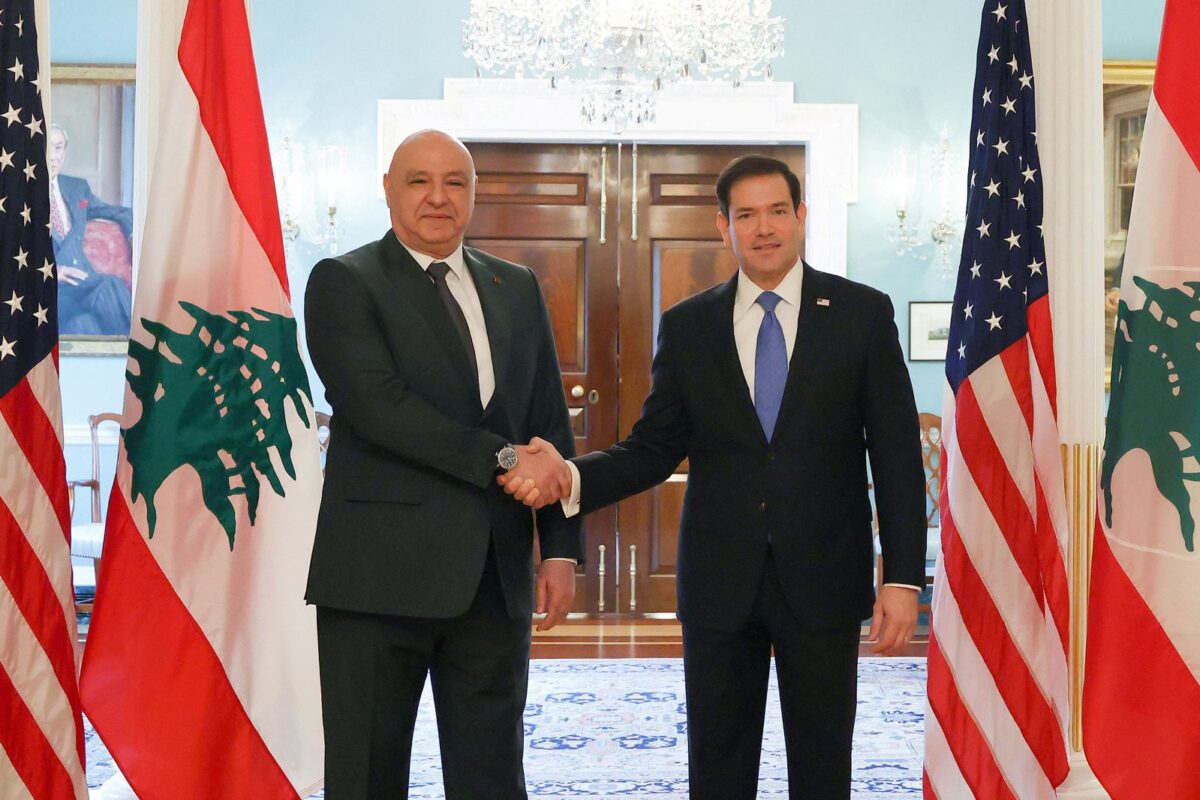
Washington, United States. Photo by- / LEBANESE PRESIDENCY / AFP
This handout photograph released by the Lebanese Presidency press office on July 19, 2026 shows Lebanon's President Joseph Aoun being received by US Secretary of State Marco Rubio in Washington, DC.
Lebanon’s President Joseph Aoun is set to meet U.S. President Donald Trump on Tuesday. Beirut is expected to push for an Israeli withdrawal from southern Lebanon and present a plan to disarm Hezbollah.
Aoun left for the U.S. on Saturday for a series of high-stakes talks with various U.S. officials. It is the first time since 2009 that a Lebanese president has visited Washington to meet with his U.S. counterpart.
Israel continues to occupy parts of southern Lebanon, including what the Israeli government calls the “security zone” — a roughly 10-kilometer-wide strip along the border — where the Israeli army has largely demolished houses, leaving thousands of Lebanese displaced.
Aoun wants Trump to “exert the necessary pressure on Israel” to implement the trilateral deal, he said last week. The Lebanese President is expected to present a written proposal to Trump on dismantling Hezbollah’s weapons arsenal, according to a Lebanese official cited by Reuters.
On Sunday, Aoun met with U.S. Secretary of State Marco Rubio and raised the issue of the Israeli withdrawal from Lebanon. A statement by the Lebanese presidency said that Lebanon and the U.S. should align their positions on implementing the framework agreement between Israel, Beirut, and Washington.
Rubio, in turn, said his meeting with Aoun was “very positive” and that Lebanon’s main problem is Hezbollah. He also said it was important for Lebanon to negotiate separately from the U.S.-Iran talks.
Last week, Lebanon and Israel held talks in Rome on implementing the U.S.-brokered trilateral framework agreement reached by all parties in late June. The deal calls for two so-called “pilot zones” on Lebanese territory, from which the Israeli military would withdraw. The Lebanese army would then be tasked with disarming Hezbollah and preventing the group from returning.
The Memorandum of Understanding between Washington and Tehran, signed on June 17, has complicated matters. It mentions the possibility of a “permanent termination” of the fighting in Lebanon — an option welcomed by pro-Hezbollah figures such as Lebanese parliament speaker Nabih Berri. The Iran-backed group does not recognize the Lebanese government’s agreement with Washington and Israel.
In Lebanon
Saudi crown prince supports Beirut: The Saudi leader Mohammed bin Salman (MBS) spoke with Lebanese President Joseph Aoun on the phone on Monday. He expressed his support for Lebanon’s “sovereignty, independence and territorial integrity” and invited Aoun to Saudi Arabia.
Rubio mentions investment in Lebanon: After his meeting with Aoun, the U.S. Secretary of State raised the possibility of U.S. and international investment in Lebanon. He also mentioned the potential resumption of direct flights between the U.S. and Lebanon.
Raï backs the framework agreement: During Sunday prayers, Maronite Patriarch Béchara Raï said Lebanon should implement the deal reached between the U.S., Lebanon, and Israel.
Qabalan criticizes Aoun: Jaafari Mufti Ahmad Qabalan, who is close to Hezbollah, criticized Aoun’s visit to the U.S., arguing that the Lebanese President was handing over power to Washington, which he claimed supports interests aligned with Israel. He also criticized Aoun for allegedly ignoring the views of Parliament Speaker Nabih Berri.
In The Region
U.S. strikes Iran: U.S. Central Command said on Monday morning that the U.S. military had struck Iran for the ninth day in a row, targeting military infrastructure including “coastal surveillance sites, maritime capabilities, missile and drone launch sites, and communications networks.” The goal of the strikes was to further degrade Iran’s ability to block the Strait of Hormuz, Centcom said.
Iran targets Kuwait, Bahrain and Jordan: On Sunday, all three Arab countries reported being struck by Iran in multiple waves. Iran’s Islamic Revolutionary Guard Corps said it had targeted U.S. bases in Jordan and Kuwait with “heavy blows.” Jordan reportedly thwarted three of four attacks, shooting down Iranian missiles. Kuwait’s air defenses reportedly intercepted drones from “an Iranian aggression,” and on Sunday a power and water plant was struck, sparking a fire. The IRGC said Tehran also targeted “U.S. military facilities” at the Ali Al Salem airbase in Kuwait. With sirens sounding across Bahrain on Monday morning, the country’s Interior Ministry told residents to seek shelter.
Iran vows to defeat the U.S.: Iranian Foreign Minister Abbas Araghchi said Tehran would only end the war once Iran had “the upper hand in the field.” He told state news agency IRNA that victory was achievable through either military means or negotiations, adding that it was essential to identify the right moment to engage in talks.
Third U.S. soldier dies over the weekend: A third U.S. service member was killed in northern Iraq on Saturday, according to CENTCOM. He died during a controlled detonation of a downed Iranian drone. He is the third American to die in the conflict, after an Iranian attack on Jordan killed two soldiers on Friday. President Donald Trump said the U.S. was hitting Iran “very hard” to honor the fallen soldiers.
What We’re Reading
Drawing the Catastrophe: The Massacres of 1860 in Mount Lebanon and Damascus Through the Illustrated Press. In this article for Now, Charles H. Al-Hayek examines two illustrations from 1860 published in the French magazine Le Monde Illustré. He analyzes the massacres in Mount Lebanon and Damascus, where around 15,000 to 20,000 Christians were killed, while another 30,000 refugees fled to Beirut. While France portrayed its intervention as a humanitarian mission, it was motivated by political and economic interests and by tensions with the Ottoman Empire, the author argues. Analyzing images of history offers a more balanced understanding of historical events by shedding light on the experiences of the people affected.
The Final Hezbollah Lifeline Runs Through the Lebanese State. In this editorial, Now examines how Hezbollah has built financial and military networks across the Middle East. Disrupting these routes will weaken the group’s power, the author argues. While Iraq has served as a source of financial support, Syria has functioned as a corridor for weapons transfers. With regional power dynamics shifting, it is still Lebanon’s responsibility to curb Hezbollah’s influence, the article argues. The government in Beirut must investigate Hezbollah’s smuggling routes and dismantle the financial and military networks that allow the organization to operate.
Two decades after the July War, Lebanon is still searching for stability. Now’s Rodayna Raydan analyzes the legacy of the 2006 conflict. Two questions remain unresolved, she argues. Who controls the decision to go to war? How can Lebanon achieve lasting stability? She interviews political analyst Mayssaa Abdelkhalek and activist Ali Assaf and explores how repeated conflicts have divided Lebanon’s political landscape, devastated southern communities, and fueled public debate over Hezbollah’s military role. Both experts argue that Lebanon can only achieve long-term security if the state exercises the power to decide between war and peace. Despite two decades of political and economic change, Lebanon still has the same unresolved problems, the author summarizes.
Rome Is the Right Place to Decide Lebanon’s Future. Now’s managing editor, Makram Rabah argues that the negotiations in Rome represent a choice between a Lebanon governed by the rule of law and one governed by armed groups. He says that Hezbollah’s disarmament is a Lebanese demand to restore national sovereignty, rather than merely an Israeli or international goal. True reform, judicial independence, and economic recovery are impossible while Hezbollah and its political allies operate a parallel system of military and political power, he argues. Lebanon’s future depends on reaffirming the power of state institutions and the rule of law over the “law of the gun,” Rabah says.