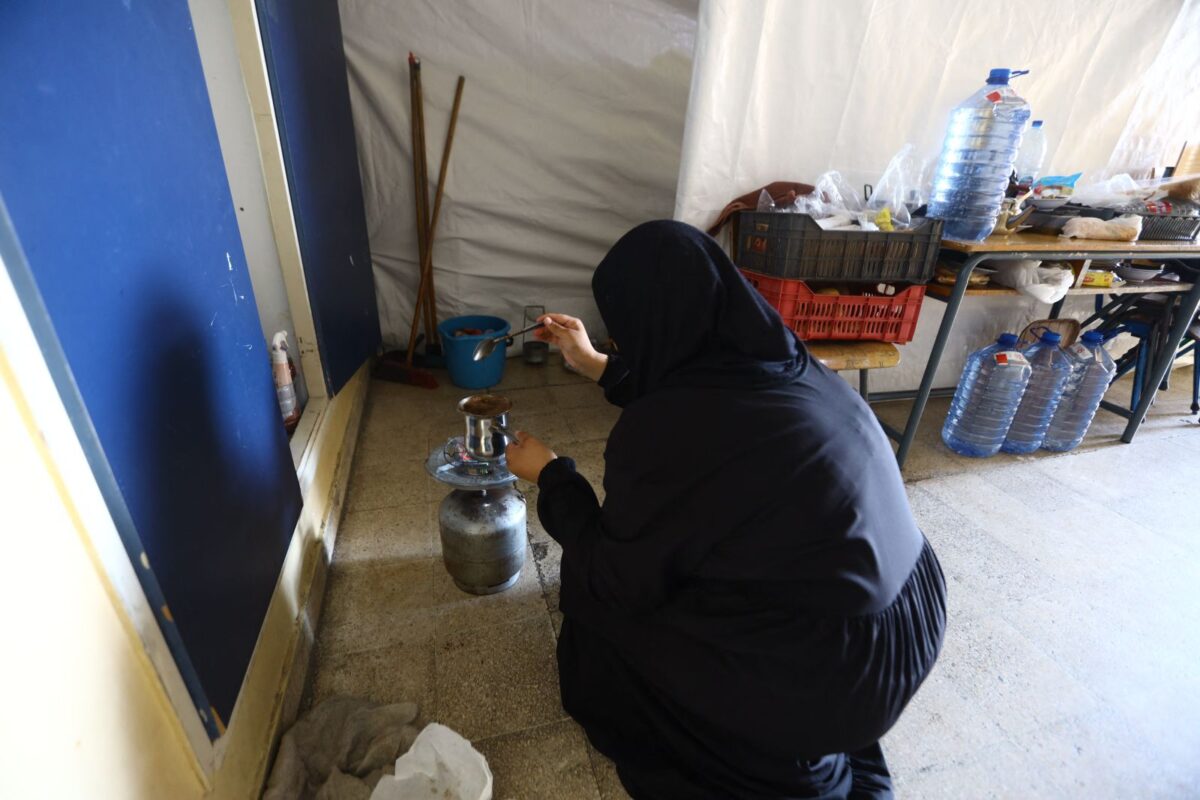
SIDON, LEBANON - JULY 13: Lebanese families displaced after their homes were destroyed or abandoned due to Israeli attacks continue to live in difficult conditions at a school serving as a shelter in the southern city of Sidon, Lebanon, on July 13, 2026. Mohammad Abushama / Anadolu (Photo by Mohammad Abushama / ANADOLU / Anadolu via AFP)
In the South, the situation remains uneven: some schools are ready to receive students, others require rehabilitation, while others have been destroyed or are still being used as shelters by displaced families.
For education authorities and humanitarian actors, the challenge is therefore not simply reopening schools, but ensuring that children can safely and consistently reach them once the academic year begins.
Yet despite repeated requests for further clarification, Lebanon’s Ministry of Education has not provided NOW with updated information on how many schools remain occupied, damaged or unable to reopen. It has also not explained what concrete measures are being taken to accommodate displaced families and affected students before September 15.
Assem Abi Ali, National Education Program Coordinator at UNESCO Beirut, told NOW that the first and most important challenge facing Lebanon’s education sector is “ensuring a safe and regular return to education for all children,” particularly those living in areas affected by the recent crisis.
According to Abi Ali, around 35,000 students remain in areas where schools are unlikely to be available to them. At the same time, some functioning schools are already hosting displaced students and may not have the capacity to accommodate additional children.
This creates a problem that extends beyond the physical condition of school buildings.
“Access to education is the first and main challenge,” Abi Ali said, pointing to the need to determine where students can actually receive education and whether alternative spaces are available.
Schools damaged, occupied or unable to reopen
The condition of school infrastructure is one of the main obstacles to a meaningful reopening.
Abi Ali said around 285 schools are currently identified as requiring partial rehabilitation, recommissioning or other forms of “soft rehabilitation” before they can reopen for the new academic year.
The issue is particularly pronounced in the South, where the condition of schools varies significantly from one area to another.
Assia Balhas, a school teacher from Hanaway in southern Lebanon told NOW that there is still considerable uncertainty over how schools in the South will operate when the academic year begins.
Some schools are capable of receiving students, she said, while others require rehabilitation, have been completely destroyed or have been converted into shelters for displaced families.
But even where a school is physically ready, Balhas warned that this does not necessarily mean that students or teachers can safely return.
“The real challenge is a safe return,” she said, explaining that a school may be open while a student is unable to reach it, or a teacher may be unable to travel between the schools where they are committed to work.
Fear and anxiety also remain major barriers to learning.
According to Balhas, the psychological environment facing children in the South cannot be separated from the question of whether schools are technically open. A child who remains afraid or under severe stress cannot necessarily benefit from being physically present in a classroom.
Abi Ali similarly stressed that preparing schools is only one part of the equation. Educational staff must also be prepared for the new academic year, including addressing the psychological wellbeing of both teachers and students.
Schools cannot reopen while families remain inside
The condition of school buildings is closely tied to the displacement crisis, which presents one of the most difficult contradictions facing the September 15 school opening.
Abi Ali said that hundreds of schools have previously been made available to displaced people, with around 400 schools having been used in this context and many requiring maintenance or rehabilitation before they can return to their educational function.
Meanwhile, displaced families remain in some schools, leaving authorities with a difficult question: where can these families go when schools need to reopen?
A source at the Ministry of Social Affairs who spoke to NOW on an anonymous basis, said the state faces significant difficulties in securing alternative accommodation.
“The first challenge facing the ministry in finding alternative accommodation for displaced families is the lack of suitable spaces to accommodate the large number of displaced people whose current shelters are already at capacity,” the source said.
Some families cannot afford to rent homes because of their financial circumstances and the destruction of their livelihoods, the source added. Many have lost their possessions and cannot return to their homes.
“There are no safe places because the state does not have an alternative plan,” the source told NOW.
The lack of suitable accommodation is also affecting families who require greater privacy or facilities adapted for people with special needs, according to the source.
“This is a very big problem,” the source said, adding that even places that could be prepared for families with special needs are not available.
The problem is further complicated by the lack of reliable and updated figures on displaced families.
Because people are continuously moving in and out of shelters, she said, it is difficult to establish an accurate number of families still requiring accommodation.
“The numbers are fluctuating between people coming and people going,” she said, adding that she did not believe there was an updated figure available.
Simply telling families to leave schools and find accommodation elsewhere is not necessarily a viable solution in her opinion, particularly when rental prices remain beyond the reach of many displaced households.
“They say, go and take care of yourselves in the houses. And the houses are expensive to rent.” She explained.
The source pointed to cases where schools remain unable to reopen because displaced families are still occupying them, even as the academic year approaches.
She cited a public school in the middle of Al-Za’arouriya that has students but cannot open, while another school is expected to reopen. In Katermaya, she said, displaced families have been placed in a vocational school, with 42 families currently there.
The situation reflects the broader difficulty of reopening schools while some continue to serve as shelters for displaced families.
For Balhas, this exposes the gap between declaring the start of a school year and actually restoring education.
“Opening schools” does not necessarily mean restoring them to their educational function or guaranteeing that all students receive the same level of education, she argued.
She warned that authorities cannot simply evacuate displaced families without providing alternatives, nor can they necessarily prepare functioning schools quickly enough for displaced students to return to classrooms.
The ministry is also a key partner in the learning-recovery and crisis-response programs described by UNESCO. But without updated public information from the ministry itself, it is difficult to assess whether those plans are operational, adequately funded or capable of addressing the scale of the problem.
The effects of years of crisis, displacement and conflict are already visible among Lebanon’s children. An assessment by the Arab Center for Research and Policy Studies warned of a “lost generation” whose education had been severely disrupted.
The report found that reading and writing skills among some sixth-grade students were equivalent to just 4.5 years of schooling. More than half of first-grade students lacked basic mathematics skills, while eight in 10 sixth-graders had not mastered division.
The disruption was even more severe among displaced children. More than half of those of primary-school age were not enrolled in school, while 60 percent of displaced adolescents were not attending secondary education.
The result is a widening gap between official announcements and conditions on the ground.
Remote learning may fill gaps, but cannot replace classrooms
With some schools unable to reopen normally, online education could become part of the response, particularly in southern areas.
But Balhas warned that remote learning is not an equitable replacement for in-person education.
Students and teachers face difficulties including electricity shortages, the cost of internet access, inadequate learning environments and the broader economic pressures associated with displacement.
For children living through displacement, she said, the ability to connect to an online class does not necessarily mean they have the conditions required to learn effectively.
This risks creating another divide between students who are able to return to functioning schools and those whose education remains dependent on alternative arrangements.
Remote learning may therefore help fill immediate gaps, but it cannot resolve the broader problems of access, safety and unequal learning conditions.
Learning loss adds another layer to the crisis
The disruption is not limited to the coming academic year.
Abi Ali said learning recovery is among UNESCO’s priorities because students have already experienced significant learning loss during the previous period of crisis.
The objective, he said, is to help Lebanese students catch up through learning-loss and learning-recovery programs being implemented by the Ministry of Education in partnership with UNESCO and other international and local organizations.
These efforts are also linked to summer schooling and support programs for Grade 12 students.
UNESCO is prioritizing psychosocial support for teachers and students as part of the recovery process.
Abi Ali said teachers’ psychological wellbeing is particularly important because educators are expected to respond to students who themselves may be experiencing significant psychological distress.
“Social psychological support for teachers is essential,” he said, stressing that teachers need support in order to adequately respond to the needs of their students.
Learning hubs and alternative education
Where traditional schools cannot immediately resume operations, alternative education arrangements are also being considered. This includes strengthening crisis preparedness at both the Ministry and school levels, as the system’s capacity to respond effectively to education emergencies remains one of its biggest challenges.
Abi Ali said the Ministry of Education is working on “Learning Hubs,” which can bring together students from several schools and provide them with educational activities and support.
Such arrangements could help prevent students from completely losing access to education while schools are being rehabilitated or while alternative arrangements are being put in place.
They also form part of a wider effort to address learning loss and maintain continuity for students whose schools cannot reopen normally.
But the experience of the South illustrates the limitations of relying on temporary solutions indefinitely.
For Balhas, the approaching September 15 deadline has created more questions than answers.
She argued that the education system is heading into the new academic year with uncertainty over how schools will function, how displaced families will be accommodated and how students and teachers will safely reach classrooms.
“The situation is not good,” she said, describing the South as an area where many people continue to leave amid the instability.
The government now faces a difficult balancing act: reopen schools without leaving displaced families without shelter, while ensuring that students in affected areas are not denied their right to education because of where they live.