A statement never issued by the President of the Republic, nor by the Prime Minister, nor by the Council of Ministers, nor jointly by the Presidency and the Government. It may never be issued. It is simply a modest attempt to articulate what most citizens may aspire to — and what day-to-day politics too often overlooks.
Fellow Lebanese,
We address you today not to describe another crisis, not to announce a temporary settlement to an old one, and not to add another promise to the many the Republic has accumulated and failed to keep. We address you because the time has come for the Lebanese state to behave like a state, and to stop treating the most basic conditions of its existence as unreasonable objectives, or as concessions that require, each time, the approval of those who have benefited from its absence.
For decades, the Lebanese have paid a heavy price for postponing the obvious: diminished sovereignty in the name of realism; arms outside the state in the name of resistance; obstruction in the name of partnership; sectarian patronage in the name of balance; corruption in the name of stability; and intimidation in the name of civil peace. Over time, the exceptions ceased to be exceptions and became a system in their own right — one in which the Constitution coexists with its opposite, the law with those who violate it, and the state with those who compete with it for its most basic functions.
That phase is over.
The Lebanese Republic is not a temporary arrangement among communities, a permanent truce among sects, or an arena for the projects of others. It is one constitutional state for all its citizens, with one territory, one sovereignty, one law, one set of institutions, and one legitimate military and security authority. On that basis, and in accordance with the Constitution, the National Accord, applicable law, international resolutions, and Lebanon’s own obligations, we place before the Lebanese a clear program for reclaiming the Republic — not as a political slogan, but as a project of government and execution.
SECURITY
The existence of any armed organization outside the institutions of the state — whatever its name, history, sect, slogans, or source of funding — is incompatible with the very principle of statehood, with the Constitution, and with the requirements of the National Accord. The Taif Agreement explicitly provided for the disbanding of Lebanese and non-Lebanese militias and the surrender of their weapons to the state, as well as for the extension of state authority over all Lebanese territory through its own forces. Relevant international resolutions have reaffirmed the same principle: no military authority, no independent security decision, and no legitimate weapon outside the Lebanese state.
Accordingly, the era of military organizations parallel to the state is over. This decision is directed against no sect, region, or social environment, nor against any citizen because of his or her political views or affiliation. It does not deny any party the right to peaceful political activity under the law. It does, however, categorically end the claimed right of any party, organization, or group to maintain an army, arsenal, independent security apparatus, military communications network, combat facilities, closed zones of influence, an independent decision over war and peace, or the freedom to operate outside the law or on behalf of a foreign state.
Under a clear phased plan, the state will deploy and reinforce the Lebanese Armed Forces and legitimate security services throughout Lebanese territory and across all land, sea, and air borders and crossings. Where necessary, the Government will seek assistance from the United States, U.S. Central Command, friendly states, and other capable partners for training, equipment, technology, intelligence, and logistical support. Command, sovereignty, authority, and decision-making, however, will remain exclusively Lebanese.
The state will not engage in a daily debate over its right to be a state, nor negotiate the principle of its sovereignty. Those who oppose government decisions politically or publicly retain every right to do so within the law. But anyone who threatens with arms, endangers civil peace, incites violence, obstructs legitimate forces in carrying out their duties, or attempts to turn enforcement of the law into a sectarian or communal confrontation will be dealt with by the competent institutions according to the act committed — not according to the cause they claim to represent.
We will explain our position to the skeptical, answer those who seek answers, and reassure those who are afraid, because a confident state does not fear explanation. But explanation is one thing; asking permission is another. A state does not ask permission to enforce its Constitution, seek a party’s approval to protect its borders, or require political consensus to end illegal arms.
A state does not ask permission to enforce its Constitution.
No cause stands above the Republic, no concern comes before the citizen, and no objective is greater than a lasting peace that protects both.
NATIONALLY
To every Lebanese citizen, from every sect, confession, and region: your guarantee is not a weapon, a leader, an embassy, or a foreign state. As experience has repeatedly shown, your guarantee is the Republic, and the Republic’s guarantee is the Constitution, the law, its institutions, and equality among citizens.
We remain committed to the national partnership on which the Republic was built, to the National Accord, and to the constitutional reforms that emerged from it. But that commitment must be matched by an explicit and final recognition by every Lebanese community of the primacy of the Lebanese Republic, the Lebanese Constitution, civil law, and state authority over any partisan, sectarian, or regional obligation. No state can be built where obedience to the law is optional, or where the Constitution is a reference book for some and a dream-interpretation manual for others.
We respect religions and religious communities and their right to administer their religious affairs within the law. We equally respect the citizen’s right not to belong to a sect, not to be religious, and not to be subject in his or her civil and political rights to any authority other than the state. We therefore call upon religious authorities and councils themselves to help free religion from politics and politics from religion, and to prevent religious institutions from becoming partisan, electoral, or security instruments.
We will no longer accept the reduction of a community to a party, or a party to a community. No party owns the Shia. No party owns the Sunnis. No party owns the Christians, the Druze, or any other Lebanese community. The citizen is an individual with full rights before being a member of a group, and the sect is a national community whose rights are protected — not political property registered in the name of an organization, family, or leader. Just as we protect one community from domination by another, we must protect the individual from his own community as well, because freedom is incomplete if the individual is free from the state but captive to his sect — or the reverse.
Nor will there be legitimacy for any clandestine or unlawful relationship between a party, organization, or sectarian institution and a foreign state or agency. Lebanon conducts international relations through the state on behalf of the Lebanese. Political parties may maintain the open political relationships permitted by law. Secret financing, foreign direction, parallel apparatuses, and organizational subordination to another state are not political pluralism. They are an erosion of sovereignty and an unlawful attachment to foreign power.
The law will apply to associations and organizations that violate the Constitution, whether the pretext is religious or ideological; that engage in military or security activity; that receive unlawful foreign financing or direction; or that operate on behalf of a foreign actor in violation of the law. An independent judiciary alone will establish the violation and impose the penalty. There can be no place for an organization that uses religion as a route to political power, nor for politics that refuses to separate religion from the state; no cause greater than the Republic, and no religious law above the Constitution.
We do not seek to abolish Lebanon’s national balance, nor to freeze it forever as it is. The objective is a gradual transition from sectarian patronage permeating every administration, appointment, and decision toward clear constitutional and political guarantees for communities, matched by equivalent guarantees for individuals, within a decentralized or federal system that distributes authority rationally between the center and the regions. The purpose is not to abolish Lebanon’s communities, but to remove them from the daily administration of the state, preserving individual and collective rights without making sectarian identity the compulsory admission card to every job, institution, and right.
Within that framework, we will redefine parity and confessional representation so that the greater part of their guarantees moves away from public employment and daily administration and into constitutional institutions and political and geographic representation. This will proceed alongside the separation of religion and state, centrally and locally, and the protection of secular and non-religious citizens to the same degree as believers and religious communities.
POLITICALLY
We will launch a constitutional and legislative process to complete what has remained unfinished since Taif and to develop what experience has shown needs development. Foremost among these reforms will be the establishment of a bicameral system: a Senate in which Lebanon’s communities are represented and which serves as the highest authority on constitutional and existential questions affecting the nature of the Republic and its fundamental balances, and a House of Representatives progressively based on national political representation and citizenship.
We do not want a ceremonial Senate added to the institutions merely to satisfy a constitutional provision that was never implemented. We want a chamber with a genuine function, one that, alongside and in complement to the President of the Republic, carries constitutional primacy and a decisive voice on fundamental matters: constitutional amendments; the identity and system of the state; war and peace; treaties affecting sovereignty; nationality; personal-status law; fundamental electoral laws; administrative or territorial divisions; and guarantees concerning Lebanon’s communities and the basic freedoms connected to them.
On these questions, a passing political majority must not be able to alter the rules of coexistence or the identity of the system without the consent of the chamber created specifically to protect them. Where a matter falls constitutionally within the Senate’s authority, its approval must be a final condition for enactment, not an advisory opinion that may simply be bypassed.
The House of Representatives, meanwhile, remains the principal political and legislative chamber for everyday government, alongside and in balance with the Council of Ministers: granting and withdrawing confidence, legislating on general matters, approving budgets, taxation, and economic and social policy, and overseeing the executive. The division is therefore clear: a Senate that protects the Republic from any majority overwhelming its constitutional compact, and a House that governs through political rather than sectarian majorities.
In parallel, we will redefine the relationship between the central government and local administrations and communities within a decentralized or federal system with clearly assigned powers, resources, and responsibilities. Lebanon needs a strong center where strength belongs at the center — sovereignty, defense, foreign policy, monetary policy, fundamental rights, and national standards — and strong regions wherever government can be more effectively administered closer to the citizen.
Decentralization or federalism is neither partition nor contradiction, just as centralization is not synonymous with unity. The unity of a state is measured by the unity of its sovereignty, Constitution, rights, and borders — not by how many signatures in Beirut are required to repair a road in Akkar, a school in the Chouf, or a hospital in the South.
We will shape that relationship so that it can accommodate the aspirations of decentralists and federalists alike, giving regions the right to administer their communities, services, development, a substantial share of their resources, and their local affairs within the general authority of the state — not apart from it and not against it.
We will therefore undertake a comprehensive review of administrative and municipal divisions and of the powers of governorates, districts, municipalities, and municipal unions, together with an objective examination of the form of decentralized or federal government best suited to Lebanon. This will proceed alongside reviews of electoral and nationality laws, party regulation, and political financing, so that the country’s administrative and electoral map reflects real communities and actual needs rather than the accumulated remains of historical compromises and temporary political interests.
Before rebuilding the political system, we must know the country we are rebuilding. We will therefore conduct the broadest possible census and measurement of Lebanese public opinion, at home and throughout the diaspora, according to independent, transparent, and scientific standards, in preparation for modern, auditable national and local elections designed to treat the Lebanese as citizens capable of choosing and holding power accountable — not as electoral herds summoned every four years to reproduce the same political class.
A Senate that protects the Republic from any majority overwhelming its constitutional compact, and a House that governs through political rather than sectarian majorities.
FOREIGN AFFAIRS
Our Republic, for all the depth of its history, the scale of its influence, and the reach of its cultural and economic presence, remains a relatively small state in geopolitical and military terms. It is therefore in Lebanon’s interest to belong to a network of alliances and partnerships with states that share its commitment to sovereignty, free enterprise, and democratic government, and whose relationships with Lebanon are compatible with its Constitution and interests. The purpose is simple: to secure the broadest and deepest possible protection for our territory, our people, and our stability.
We need hardly remind ourselves of Lebanon’s contributions since the founding of the modern state: to the drafting of the Universal Declaration of Human Rights, to the early life of the United Nations, to the modernization and dissemination of the Arabic language, and to the establishment of the Arab League. Nor should we forget the price Lebanon paid in a long Arab-Israeli conflict that it sought, from the outset, not to become the permanent arena for.
We will not judge our relations with Syria, Turkey, Iran, Israel, Cyprus, or any other near or distant state through inherited slogans or ideological alignments. We will judge them by their respect for Lebanon, its sovereignty, and its interests, and by their willingness to deal with it on the basis of reciprocity. No ideological dogma can impose eternal enmity, and no permanent friendship can justify sacrificing Lebanese interests.
We will seek, first and foremost, to develop a strategic relationship with the United States, while deepening our ties with Europe and the United Kingdom, the states of the Eastern Mediterranean, the Gulf Cooperation Council, the countries of the Lebanese diaspora, and other states that are friendly and important to Lebanese interests. Lebanon’s relations with the world will rest on a clear rule: mutual respect first, shared interests second, and no external relationship at the expense of Lebanese sovereignty or national decision-making.
ADMINISTRATIVELY
A new Republic cannot be built with an old administration. We will therefore insist without compromise on the separation of powers, judicial independence, administrative competence, and political and religious neutrality, and on a principle long absent from Lebanese practice: public office is a service, not the property of a party or sect, and the administration exists to serve citizens, not manage them as clients of a leader or political office.
We will undertake the comprehensive digitization of the state, connect its databases, and modernize its financial, oversight, information, intelligence, and security systems within a strict legal framework protecting citizens’ privacy and defining precisely the authority to collect, access, and use information. We want a state that knows what it needs to know to protect its citizens and their public wealth — not a state that spies on them. Technology must create a more efficient state governed by law, not a more corrupt police state.
In parallel, we will launch an integrated judicial, financial, regulatory, and security process to pursue corruption and recover public and private funds and rights, beginning with the largest, best-documented cases and those that have most severely affected citizens’ lives. This will not be political revenge or a spectacle of public humiliation. But neither will it submit to bargains designed to protect those responsible. No political immunity for the corrupt, no sectarian protection for thieves, and no partisan settlement for offenders.
A broad restructuring of public administrations and institutions will eliminate duplication, merge overlapping bodies, close channels of waste, and redistribute human resources according to need and competence. Municipalities and their unions will simultaneously be strengthened financially, administratively, and institutionally so that they become the principal executive foundation of any serious decentralized or federal system rather than impoverished institutions waiting for transfers from the capital.
The state will also conduct a modern, comprehensive national inventory and census of its assets, property, resources, citizens and residents, as well as the Lebanese diaspora worldwide. A country cannot be governed when its state does not know precisely what it owns, who lives on its territory, where its citizens are, what its regions need, or the extent of its human, real-estate, and economic wealth. Knowledge is not an administrative detail. It is the first requirement of serious public policy.
ON THE GROUND
None of the above matters if it remains ink on paper. The priority will therefore be phased, measurable execution — not the production of more plans destined for drawers.
Any official or officer proven to have engaged in corruption, collusion, deliberate obstruction of legitimate decisions, or violation of the law will be referred to the appropriate judicial and oversight authorities. In accordance with law and due process, anyone in a position of authority who refuses to execute lawful orders within his jurisdiction will be removed from that position. The state cannot ask citizens to respect its decisions while its own officials and officers decide for themselves which decisions they will implement and which they will obstruct.
The state will fulfill the obligations arising from agreements and negotiations approved by its constitutional institutions swiftly and confidently, without hesitation or historical complexes, while surrendering neither an inch of Lebanese territory nor any Lebanese right. Monopolizing arms is not aggression; negotiation is not surrender; and peace is not defeat. A state that knows its interests and its rights does not fear confronting terrorism or sitting at a negotiating table. It should fear others speaking in its name or negotiating its future while it remains absent.
This will be accompanied by a security and administrative plan beginning with full state control over administrative Beirut, followed by Greater Beirut, the airport, the port, the capital’s entrances, and its critical infrastructure, while simultaneously securing all borders and crossings and extending state authority over every area in which current military operations have ended. A state cannot credibly demand full sovereignty over its territory while its own capital contains areas, facilities, or networks over which its institutions lack complete control.
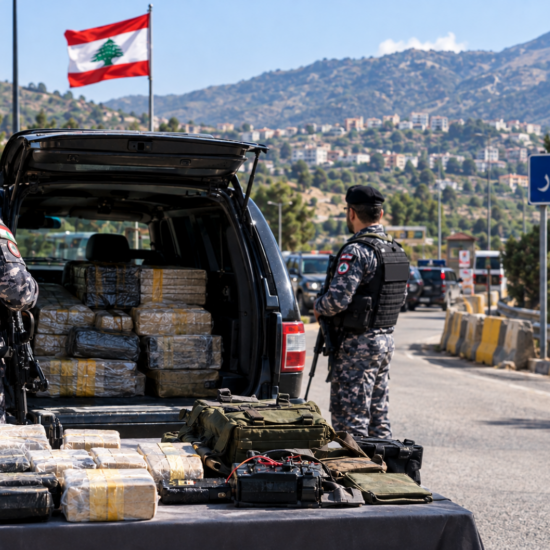
Border control will be comprehensive: demarcation wherever demarcation is required; permanent technological and human surveillance; suppression of smuggling; and prevention of the movement of weapons, fighters, and illicit funds in either direction. The Government will then announce a phased timetable for extending effective state authority across every district, beginning with the least penetrated and most readily secured areas, and expanding continuously and systematically until it reaches every village, every neighborhood, and every kilometer of Lebanese territory.
There will be no territory forbidden to the state, because territory forbidden to the state is territory over which its sovereignty is merely nominal. Lebanon will be in the strongest possible position to compel a complete Israeli military withdrawal, and to secure it with the assistance of the United States and friendly states, once all unlawful military presence on Lebanese territory has ceased.
On displacement and refugees, the state will establish, in cooperation where necessary with relevant states and international bodies, organized accommodation centers in safe areas under its full authority, allowing identity, movement, residency, services, and security to be properly regulated while respecting human dignity and legal obligations. It will organize the dignified return of displaced Lebanese to their villages, and of refugees to their countries or lawful places of residence. A comprehensive review will also address the status of foreigners and unlawful residents, while naturalization cases tainted by fraud, forgery, or violations of law will be reopened.
The principle will be simple: those with a legal right will be protected by the state; those without one will be subject to lawful procedures; and anyone who obtained citizenship fraudulently or unlawfully will have his or her case referred to the competent authority for whatever revocation is permissible under the Constitution and law. There will be no collective punishment and no targeting based on ethnicity, religion, or nationality. But demographic and legal disorder will no longer constitute state policy merely because it is easier than enforcing the law.
Monopolizing arms is not aggression; negotiation is not surrender; and peace is not defeat.
AND THE EXCUSES
We already know the objections. We will be told that the time is not right, that national unity is fragile, that civil peace is threatened, that the administration is incapable, that the army needs time, that the international community may not provide sufficient support, that regional circumstances are delicate, and that some issues must wait for others. We also know that those who repeat these arguments most insistently are precisely those for whom the emergence of the state would be least convenient.
The Lebanese have heard these arguments for decades, until exceptions became a system of government, postponement became public policy, and incapacity became a national doctrine. Whenever an opportunity arose to rebuild the state, we were told that preserving unity required postponing it; that protecting civil peace required accommodating those who threatened it; that administrative weakness prevented administrative reform; and that the army’s limited capabilities required accepting another armed force alongside it. The disease became the argument against the cure.
We say precisely the opposite. The absence of parallel armed organizations strengthens national unity because it frees communities from fear of one another. The state’s monopoly over arms protects civil peace because it turns political disagreement into disagreement rather than potential war. Enforcement of the law revitalizes the administration by restoring the meaning of decision and responsibility. Ending parallel armies does not weaken the Lebanese Armed Forces; it finally gives them the status and role that any national army should possess.
To argue that the state is not yet ready to exercise sovereignty is to reverse cause and effect. A state does not first become ready to exercise sovereignty and then exercise it; it becomes ready by beginning to exercise it. An army does not first become strong and then monopolize armed force; it grows strong when the Republic decides that it is the only army. An administration does not become competent before being entrusted with responsibility; it becomes competent when failure, misconduct, and obstruction carry consequences.
Fellow Lebanese,
We are not proposing another rearrangement of the Lebanese crisis, nor another attempt to manage the balance between the institutions of the state and the institutions of the non-state. We have an opportunity to end that duality and move from a Republic that continually negotiates its right to exist to one that regards its existence as a right beyond negotiation.
We will not promise that the road will be easy. There will be political resistance, threatened interests, money, influence, propaganda, and attempts to provoke sectarian fear, because many forces have learned to derive their strength from the weakness of the state, and they will not celebrate its return. But the Republic cannot make its right to live dependent upon the consent of those who profit from its absence.
We want a Lebanon in which a Shia can be Shia without belonging to a party; a Christian can be Christian without searching for a protector; a Sunni can be Sunni without needing a patron; a Druze can be Druze without fearing numbers or geography; a secular citizen can be secular, an atheist can be an atheist, and a citizen can be a citizen before anything else. We want a state that protects difference without becoming a compact of mutual fears; that protects communities without imprisoning individuals within them; and that does not ask Lebanese citizens to abandon their identities, but prevents any one of those identities from erasing their Lebanese one.
We want a decentralized or federal system that allows these communities to administer most of their local affairs, reassuring one another instead of competing endlessly for control of the central state. The greater a region’s ability to manage what concerns it, the less it must fear others managing the details of its life; and the clearer the center’s authority over fundamental sovereign matters, the more united Lebanon becomes, not less.
We will not measure the success of this period by the number of statements we issue, conferences we hold, or dialogue tables we convene. We will measure it by whether the state has one weapon and real borders; whether the law is stronger than the political leader and the judiciary stronger than the telephone call; whether public office goes to the competent rather than the connected; and whether citizens are safe both from arbitrary state power and from those who would challenge it. We will also measure it by whether decisions of war and peace, foreign policy, and the future of the Republic are made inside the institutions of the Lebanese state — not in any other capital.
These are not the demands of one group of Lebanese upon another. This is not a project for the victory of one sect over another, nor the replacement of one form of domination with another. These are the conditions for the existence of the Republic itself.
For too long, we have asked how to preserve peace without building the state, how to preserve unity without agreeing on its rules, how to preserve the army without granting it the monopoly of force, and how to preserve our communities by keeping them afraid of one another.
It is time to reverse the equation.
Build the state, and peace becomes a natural consequence of its existence. Protect the individual, and the community becomes secure. Distribute power through decentralization or federalism, and protect the unity of the Republic from the endless struggle for control of its center. Entrust existential questions to a strong Senate, and ordinary political competition to a political House of Representatives. Entrust force exclusively to legitimate institutions, so that political disagreement becomes safe rather than the prelude to war.
No cause is greater than the Republic. No concern is greater than the citizen. No objective is greater than peace.
And with these three, we begin.
Eli Khoury is the publisher of NOW_leb. He tweets @eli_khoury