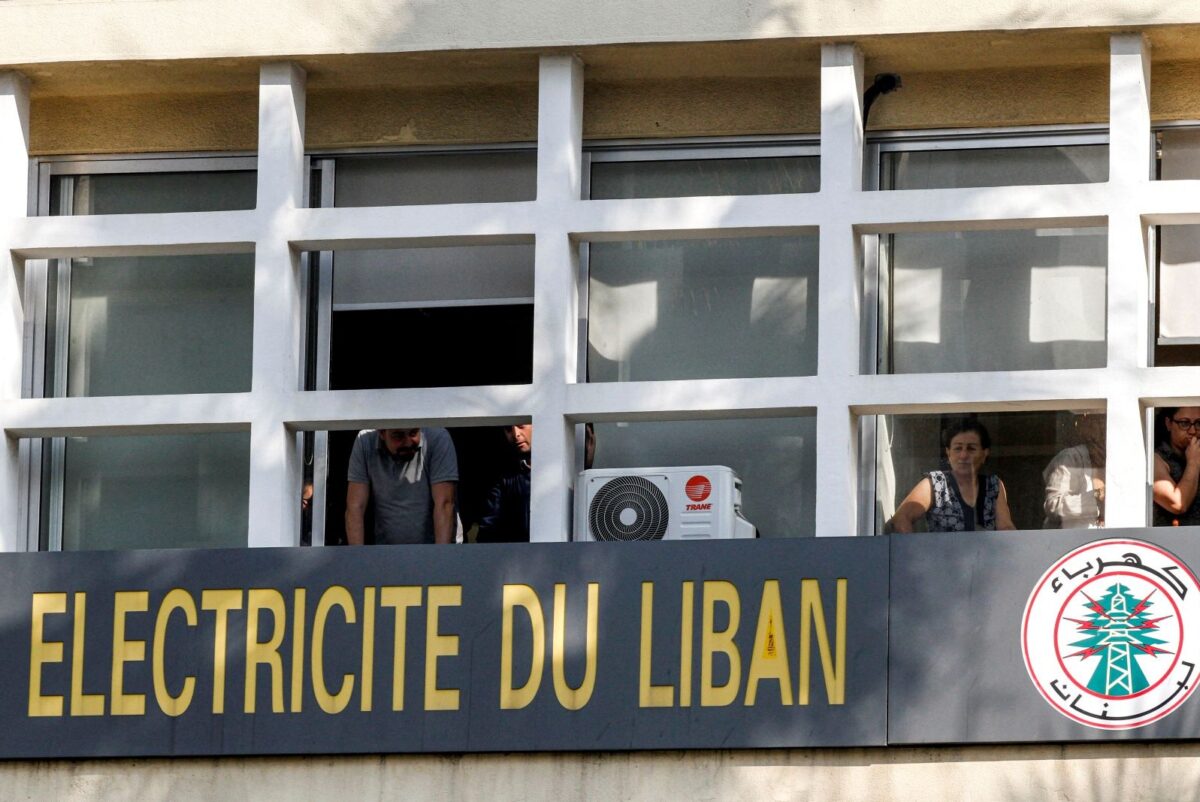
Photo by MAHMOUD ZAYYAT / AFP. Employees of the Electricite du Liban (Electricity Of Lebanon) national company look out of their windows at students gathering for an anti-government demonstration outside, in the southern city of Sidon on November 6, 2019.
Lebanon’s electricity problem has never suffered from a shortage of plans. For decades, governments, international institutions and experts have proposed reforms to restore reliable electricity and restructure Electricité du Liban (EDL). Many were expensive, difficult to sustain, or failed to address the political economy that has repeatedly obstructed reform. Yet today, that is not even the most immediate problem.
The problem today is increasingly one of feasibility.
A comprehensive, sustainable solution requires substantial capital, political commitment, and years of implementation. Lebanon currently has little to none of all three. The financial crisis constrains investment and investor appetite, while political and security instability increases the risks of large infrastructure projects. Meanwhile, AI-driven global demand for critical power equipment, including gas turbines, has contributed to shortages and long lead times, making immediate expansion of conventional generation more difficult and expensive. Most importantly, the political will for comprehensive structural reform remains uncertain. This does not mean Lebanon should abandon rebuilding its electricity sector or keep investing in short-term band-aids.
Lebanon needs to distinguish between the system it wants to build and what it can realistically do now. The immediate priority should be simple: reduce the burden on EDL.
Lebanon needs to distinguish between the system it wants to build and what it can realistically do now. The immediate priority should be simple: reduce the burden on EDL.
This means addressing three parts of the electricity equation: 1) reduce electricity losses, 2) reduce electricity demand, and 3) decentralize the supply of part of what remains.
First: Stop losing electricity
Lebanon cannot make EDL financially viable while paying consumers bear the cost of electricity theft and non-payment. In 2023, losses across EDL’s network were estimated at around 40%, according to the World Bank. While some are technical, a significant share is non-technical, including illegal connections, inadequate metering, non-billing and non-collection.
Since subsidies were removed and tariffs increased in 2022, and two wars took place, it is highly likely that these losses have increased. High non-technical losses have been increasing the burden on compliant consumers.
Before investing scarce capital in new generation, Lebanon should maximize existing electricity and revenue: remove illegal connections, accelerate smart metering, improve billing and collection, and establish measurements and accountability for distribution losses. Network digitalization and rehabilitation will also be needed to tackle technical losses.
But the biggest challenge is political, rather than technical. Enforcement must apply consistently across regions and consumer groups; otherwise, adding generation risks increasing costs while keeping service unreliable.
But the biggest challenge is political, rather than technical. Enforcement must apply consistently across regions and consumer groups; otherwise, adding generation risks increasing costs while keeping service unreliable.
Second: The cheapest megawatt is the one Lebanon does not need
Before Lebanon decides how much new generation to build, it needs to determine how much electricity it actually needs. The debate has traditionally focused on how much capacity to add, which power plants to build and what temporary solutions to deploy, while paying far less attention to demand.
The most important study Lebanon needs today is therefore a robust demand assessment, with demand-side management becoming a core pillar of electricity policy and energy security. Efficiency measures can reduce consumption, while time-of-use tariffs and demand-response mechanisms can eventually shift demand away from periods of greatest system stress.
In Lebanon’s constrained environment, reducing demand reduces the scale and cost of the entire electricity challenge: less generation and fuel are required, pressure on networks falls, and less new capacity needs to be financed.
Third: Move from individual solar to localized electricity systems
Lebanon now needs to move from fragmented individual solar systems towards organized, localized electricity networks. The boom in rooftop solar and batteries has provided a critical response to unreliable public electricity, but has resulted in disconnected individual systems, since it was driven by institutional and policy failure.
The next step should be properly designed mini-grids serving neighborhoods, villages, industrial clusters and critical facilities, combining solar PV, battery storage and backup generation. Rather than creating permanent electricity islands, these systems should be designed to eventually integrate with and strengthen the national grid.
Decentralization does not mean dismantling EDL. A functioning electricity sector still requires a national utility responsible for system planning, transmission, balancing and other system-wide functions. But EDL does not need to supply every electricity unit. Local utilities, municipalities, and private developers can serve defined areas, reducing the load on EDL while allowing it to focus on functions only a national system can perform.
But mini grids need rules
Lebanon’s informal private diesel generators demonstrate both the value of local electricity supply when the state cannot provide it, and the ability to fully collect its fees, but also the dangers of allowing decentralization to develop without adequate oversight.
Mini-grids require clear rules on technical standards, consumer protection, quality of service. They should also be designed for eventual integration with the national network.
Finance what can actually be built
Lebanon’s banking crisis, high sovereign and counterparty risk, and competing national needs make financing a comprehensive electricity overhaul difficult. This makes sequencing critical.
Loss reduction and demand-side management can reduce the capital ultimately required, while decentralized projects can break investment into smaller, potentially more financeable components.
Villages and towns, industrial zones, hospitals, universities and commercial clusters could provide starting points for mini grids. Financing could combine private investment, commercial and industrial consumers, and potentially the Lebanese diaspora.
Don’t wait for the perfect solution, but don’t deploy band-aids either
Lebanon cannot wait for the conditions for comprehensive reform to be perfect. Yet it should not keep investing in temporary fixes. Reducing losses, managing demand and developing localized electricity systems will not solve the crisis, but they can reduce its scale while broader structural reforms remain difficult.
With capital, political commitment and time all in short supply, making the problem smaller may be the most realistic place to start.
Jessica Obeid is the Founding Partner of New Energy Consult, a Dubai-based consultancy, and an electrical engineer and strategist with nearly two decades of international experience across the power sector value chain. She holds board and senior advisory roles across the public and private sectors and international institutions.
The views in this story reflect those of the author alone and do not necessarily reflect the beliefs of NOW.