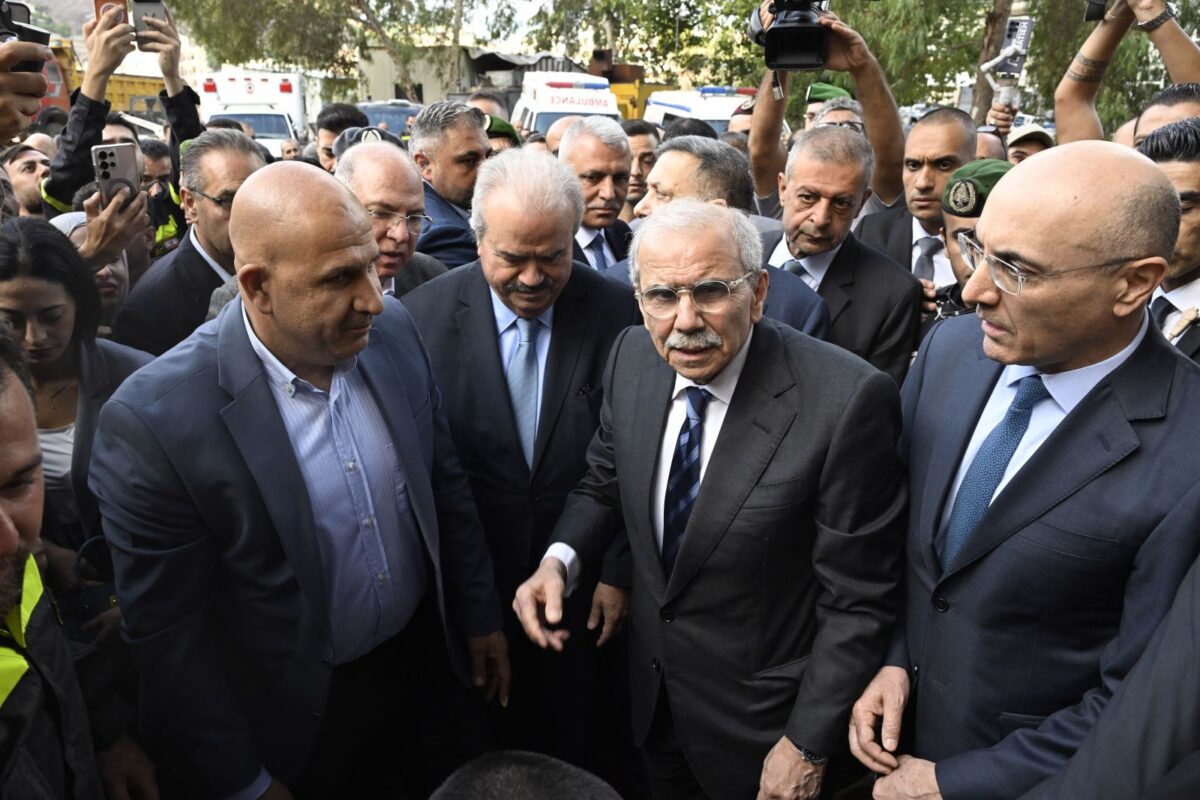
NABATIEH, LEBANON - OCTOBER 02: Lebanese Prime Minister Nawaf Salam and his accompanying delegation visit Lebanese city of Nabatieh, which Israel has frequently targeted with attacks on its towns and villages despite the ceasefire, on October 02, 2026. Houssam Shbaro / Anadolu (Photo by Houssam Shbaro / ANADOLU / Anadolu via AFP)
Nawaf Salam visits South Lebanon as government seeks to restore state authority
Prime Minister Nawaf Salam visited Nabatieh on Friday, October 2, in a high-profile trip aimed at reaffirming the Lebanese state’s presence in a region devastated by successive rounds of fighting between Israel and Hezbollah. Salam acknowledged that the scale of destruction, displacement and lost livelihoods exceeded the state’s capacity to respond alone, stressing the need for substantial reconstruction funding.
During the visit, Salam said the government was working to restore the role of state institutions and secure the conditions for a full Israeli withdrawal. He also called for support to prevent another war and ensure that decisions over war and peace rest with the state. The visit came as southern Lebanon continued to face Israeli attacks despite the June ceasefire, while Israeli forces remained deployed inside Lebanese territory.
The visit also underscored the gap between the government’s political commitments and its ability to deliver recovery on the ground. The estimated cost of the two recent wars could exceed $27 billion, according to figures cited by Salam, while hundreds of thousands of people remain displaced. The challenge is not only rebuilding damaged infrastructure but restoring livelihoods and enabling residents to return safely.
UAE Investigates Flydubai Incident as Attempted Terrorist Attack
In a separate regional security development, the UAE’s prosecutor general said investigations into a Flydubai flight diverted to Saudi Arabia had found that the co-pilot attempted to carry out a terrorist attack. The incident occurred aboard flight FZ1073, which was travelling from the UAE to Israel on September 30.
According to UAE authorities, the co-pilot attacked the captain inside the cockpit with an emergency axe and attempted to take control of the aircraft. A reserve pilot travelling on the flight intervened and landed the plane safely at Tabuk airport in northwestern Saudi Arabia. More than 170 passengers and crew were on board, most of them Israeli nationals.
The UAE said investigations into the suspect’s motives, possible links and any prior planning remained ongoing. The announcement marked the first public description by Emirati investigators of the incident as an attempted terrorist attack. Flydubai said the circumstances were still under investigation and declined to comment further.
In Lebanon
Israeli forces destroy school and shell southern towns: Israeli forces carried out a series of demolitions, airstrikes and artillery attacks across southern Lebanon on Saturday, with the reported destruction of a private school in Houla in the Marjayoun district among the latest incidents. Explosives were reportedly placed inside the school before it was demolished, while homes in the town were also set on fire.
Lebanese prisoners continue hunger strike: The situation of Lebanese prisoners who had been on hunger strike for 18 days as of September 30 is deteriorating. There are concerns over their condition and renewed attention to the treatment and legal circumstances of Lebanese detainees. International bodies were becoming involved as the hunger strike at Roumieh prison continued.
UK reaffirms support for Lebanon’s security: British Deputy Chief of Defence Staff Lieutenant General Sir Charlie Collins concluded a visit to Lebanon on September 29, during which he met senior Lebanese political and military officials and the UN special coordinator. The British embassy said discussions focused on the security situation in the south and the Lebanese Armed Forces’ role in safeguarding sovereignty and supporting state authority. Collins reaffirmed the UK’s continued support for the army and diplomatic efforts to reduce tensions.
UN warns of mounting damage to agriculture: Food and Agriculture Organization Deputy Director-General Beth Bechdol said the latest conflict had placed further pressure on farmers and rural communities. An estimated 56,000 hectares—more than 22 percent of Lebanon’s agricultural land—had been reported affected or damaged. Farmers face disrupted access to their land, inputs and markets, while unexploded ordnance and possible soil contamination pose additional risks.
In The Region
More tankers struck amid tensions with Iran: There were further attacks on tankers in Gulf waters as Iran reiterated its conditions amid continuing regional tensions. The incidents raised fresh concerns over maritime security, energy shipments and the risk of further disruption to global oil trade.
UAE describes Flydubai incident as attempted terrorist attack: Emirati investigators said the co-pilot of flight FZ1073 attacked the captain with an emergency axe and attempted to take control of the aircraft. The plane diverted to Saudi Arabia and landed safely. Investigators are continuing to examine the motive and any possible links.
Trump says further bombing of Iran remains possible: US President Donald Trump said additional strikes on Iran could take place after the midterm elections. His remarks point to the continued uncertainty surrounding Washington’s approach to Tehran and the risk of renewed military escalation.
US removes Syria from arms-export ban: The United States has removed Syria from an arms-export restriction. The move could affect future defence-related transactions and reflects a change in Washington’s policy framework toward Damascus.
US formally concludes its mission in Iraq: The United States has formally concluded its military mission in Iraq. The development marks a change in the US military role in the country, with implications for security cooperation and the wider regional balance.
What We’re Reading
Hezbollah Is Lebanon’s Altalena; Aoun Refuses to Sink It!- Franck Salameh draws a historical parallel between Hezbollah’s independent military structure and the Altalena Affair in Israel in 1948, when the newly established Israeli military confronted the Irgun paramilitary group over weapons and the question of who held legitimate military authority. The article uses this comparison to examine President Joseph Aoun’s approach to Hezbollah’s weapons and the difficulty of establishing a state monopoly on force.
The Last Export Nobody May Want – Khalil Gebara examines Lebanon’s declining education standards through the results of the OECD’s PISA assessment, which measures how effectively 15-year-olds apply their knowledge in reading, mathematics and science. He argues that Lebanon’s longstanding reputation for producing well-educated graduates cannot compensate indefinitely for weaknesses in public education, university governance and learning outcomes.
Lebanon’s $14 Billion Question: In or Out of the Club? Elissa El Hachem examines Lebanon’s exclusion from a meeting involving countries participating in the Abraham Accords framework and the wider implications for its economic and diplomatic position. She contrasts Lebanon’s circumstances with those of countries pursuing regional partnerships and investment opportunities, highlighting the economic consequences of remaining outside emerging regional arrangements. The article cites the World Bank’s estimate of $14 billion in damage and losses from the latest war, including destroyed buildings and lost economic output, alongside the substantial funding required for reconstruction.
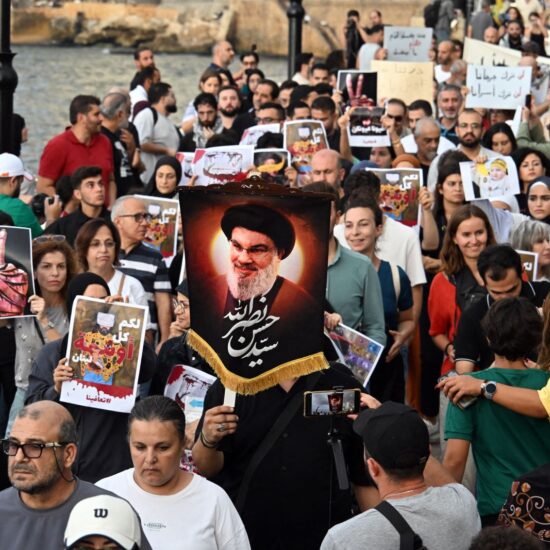
Hezbollah’s Survival Is Not Shia Recovery – Ramzi Abou Ismail challenges the idea that Hezbollah’s continued organisational survival necessarily represents recovery for Lebanon’s Shia community. Writing after Naim Qassem’s speech marking the anniversary of Hassan Nasrallah’s death, Abou Ismail contrasts the group’s emphasis on endurance and retaining its weapons with the immediate needs of families affected by war. He argues that people require security, homes, livelihoods and the ability to plan their futures, rather than declarations that the organisation remains standing.
Who Came First? Lebanon’s Religious Communities at War Over the Past – Charles H. al-Hayek explores how Lebanon’s religious communities developed over centuries of political change, migration, conversion and cultural exchange. He challenges popular narratives that present the country’s communities as competing to prove which arrived first or has the strongest historical claim to the land. Drawing on historical records, archaeology and collective memory, al-Hayek argues that most of Lebanon’s population has deep local roots, while religious identities evolved over time.